![[BunsenLabs Logo]](/img/bl.svg)
You are not logged in.
- Topics: Active | Unanswered
#21 Yesterday 14:12:35
- hhh
- Hercule Poirot

- From: Belgium
- Registered: 2015-09-17
- Posts: 17,495
- Website
Re: (Wayland forky/sid) HowTo: deb packages for niri-wm (easy!)
@unklar, to make audacious open floating, make a window rule for it. First find it's ID by opening audacious, then running 'niri msg windows' in a terminal. Then create a window-rule in ~/.config/niri/config.kdl...
// Open apps in floating windows
window-rule {
    match app-id="audacious"
    open-floating true
    default-column-width { fixed 750; }
    default-window-height { fixed 470; }

}
You can also run 'niri msg layers' to get noctalia namespace IDs. Run 'niri msg outputs' to ID your monitor(s). Run 'niri msg pick-color' to pick a color from your screen. Run 'niri msg --help' to see all msg options.
Note, I've had audacious crash badly using the default GTK settings, I'm having better luck running it using Xwayland (In Audacious: File>Settings>Advanced>Use Xwayland). In that case, 'match app-id="Audacious"', upper-case A.
Here's my laptop's current config.kdl that includes noctalia stuff. I've tried to clean up the default and added some comments, use at as a reference along with https://github.com/niri-wm/niri/blob/ma … config.kdl. Note 'focus-ring' (off), 'border' (// off a.k.a on) in the 'layout' section and 'prefer nocsd' before my layer-rules, you can get a much more unified look than what you have.
spawn-at-startup "/usr/libexec/xdg-desktop-portal-wlr"
// Start Noctalia
spawn-at-startup "noctalia"


input {

    // Use the second option if you like mouse-hover to avtivating windows (I'm not a fan.)
    // warp-mouse-to-focus
    // focus-follows-mouse //  I don't know if this has its own modes, see the Niri docs
    warp-mouse-to-focus mode="center-xy-always"

    keyboard {
        xkb {
            options "caps:none"
        }
    }

    touchpad {
        tap
        // natural-scroll
        accel-speed 0.2
    }

}

output "eDP-1" {
    // off
    mode "1920x1080@60.056"
    scale 1.0
}

output "HDMI-A-1" {
    // off
    mode "1920x1080@60.0"
    scale 1.0
}

// Disable the hot corners.
gestures {
    hot-corners {
        off
    }
}


layout {

    // Set gaps around windows in logical pixels.
    gaps 12

    // When to center a column when changing focus, options are:
    // - "never", default behavior, focusing an off-screen column will keep at the left
    //   or right edge of the screen.
    // - "always", the focused column will always be centered.
    // - "on-overflow", focusing a column will center it if it doesn't fit
    //   together with the previously focused column.
    center-focused-column "never"

    // You can customize the widths that "switch-preset-column-width" (Mod+R) toggles between.
    preset-column-widths {
        // Proportion sets the width as a fraction of the output width, taking gaps into account.
        // For example, you can perfectly fit four windows sized "proportion 0.25" on an output.
        // The default preset widths are 1/3, 1/2 and 2/3 of the output.
        proportion 0.33333
        proportion 0.5
        proportion 0.66667

        // Fixed sets the width in logical pixels exactly.
        // fixed 1920
    }

    // You can also customize the heights that "switch-preset-window-height" (Mod+Ctrl+Shift+R) toggles between.
    // preset-window-heights { }

    // You can change the default width of the new windows.
    default-column-width { proportion 0.5; }
    // If you leave the brackets empty, the windows themselves will decide their initial width.
    // default-column-width {}

    // By default focus ring and border are rendered as a solid background rectangle
    // behind windows. That is, they will show up through semitransparent windows.
    // This is because windows using client-side decorations can have an arbitrary shape.
    //
    // If you don't like that, you should uncomment `prefer-no-csd` below.
    // Niri will draw focus ring and border *around* windows that agree to omit their
    // client-side decorations.
    //
    // Alternatively, you can override it with a window rule called
    // `draw-border-with-background`.

    // You can change how the focus ring looks.
    focus-ring {
        // Uncomment this line to disable the focus ring.
        off

        // How many logical pixels the ring extends out from the windows.
        width 4

        // Colors can be set in a variety of ways:
        // - CSS named colors: "red"
        // - RGB hex: "#rgb", "#rgba", "#rrggbb", "#rrggbbaa"
        // - CSS-like notation: "rgb(255, 127, 0)", rgba(), hsl() and a few others.

        // Color of the ring on the active monitor.
        active-color "#7fc8ff"

        // Color of the ring on inactive monitors.
        //
        // The focus ring only draws around the active window, so the only place
        // where you can see its inactive-color is on other monitors.
        inactive-color "#505050"

        // You can also use gradients. They take precedence over solid colors.
        // Gradients are rendered the same as CSS linear-gradient(angle, from, to).
        // The angle is the same as in linear-gradient, and is optional,
        // defaulting to 180 (top-to-bottom gradient).
        // You can use any CSS linear-gradient tool on the web to set these up.
        // Changing the color space is also supported, check the wiki for more info.
        //
        // active-gradient from="#80c8ff" to="#c7ff7f" angle=45

        // You can also color the gradient relative to the entire view
        // of the workspace, rather than relative to just the window itself.
        // To do that, set relative-to="workspace-view".
        //
        // inactive-gradient from="#505050" to="#808080" angle=45 relative-to="workspace-view"
    }

    // You can also add a border. It's similar to the focus ring, but always visible.
    border {
        // The settings are the same as for the focus ring.
        // If you enable the border, you probably want to disable the focus ring.
        // off

        width 1
        active-color "#ffc87f"
        inactive-color "#505050"

        // Color of the border around windows that request your attention.
        urgent-color "#9b0000"

        // Gradients can use a few different interpolation color spaces.
        // For example, this is a pastel rainbow gradient via in="oklch longer hue".
        //
        // active-gradient from="#e5989b" to="#ffb4a2" angle=45 relative-to="workspace-view" in="oklch longer hue"

        // inactive-gradient from="#505050" to="#808080" angle=45 relative-to="workspace-view"
    }

    // You can enable drop shadows for windows.
    shadow {
        // Uncomment the next line to enable shadows.
        on

        // By default, the shadow draws only around its window, and not behind it.
        // Uncomment this setting to make the shadow draw behind its window.
        //
        // Note that niri has no way of knowing about the CSD window corner
        // radius. It has to assume that windows have square corners, leading to
        // shadow artifacts inside the CSD rounded corners. This setting fixes
        // those artifacts.
        //
        // However, instead you may want to set prefer-no-csd and/or
        // geometry-corner-radius. Then, niri will know the corner radius and
        // draw the shadow correctly, without having to draw it behind the
        // window. These will also remove client-side shadows if the window
        // draws any.
        //
        // draw-behind-window true

        // You can change how shadows look. The values below are in logical
        // pixels and match the CSS box-shadow properties.

        // Softness controls the shadow blur radius.
        softness 20

        // Spread expands the shadow.
        spread 2

        // Offset moves the shadow relative to the window.
        offset x=0 y=0

        // You can also change the shadow color and opacity.
        color "#0007"
    }

    // Struts shrink the area occupied by windows, similarly to layer-shell panels.
    // You can think of them as a kind of outer gaps. They are set in logical pixels.
    // Left and right struts will cause the next window to the side to always be visible.
    // Top and bottom struts will simply add outer gaps in addition to the area occupied by
    // layer-shell panels and regular gaps.
    struts {
        // left 64
        // right 64
        // top 64
        // bottom 64
    }

    background-color "transparent"
}


cursor {
    xcursor-theme "Breeze_Light"
    // xcursor-size 24
    // Hide the cursor after one and a half seconds of inactivity, uncomment to always show the cursor.
    hide-after-inactive-ms 1500
}

animations {
    // Uncomment to turn off all animations.
    // off

    // Slow down all animations by this factor. Values below 1 speed them up instead.
    slowdown 1.25
}


binds {
    // Keys consist of modifiers separated by + signs, followed by an XKB key name
    // in the end. To find an XKB name for a particular key, you may use a program
    // like wev.
    //
    // "Mod" is a special modifier equal to Super when running on a TTY, and to Alt
    // when running as a winit window.
    //
    // Most actions that you can bind here can also be invoked programmatically with
    // `niri msg action do-something`.

    Mod+O repeat=false { toggle-overview; }

    Mod+Q repeat=false { close-window; }

    Mod+Left  { focus-column-left; }
    Mod+Down  { focus-window-down; }
    Mod+Up    { focus-window-up; }
    Mod+Right { focus-column-right; }
    Mod+H     { focus-column-left; }
    Mod+J     { focus-window-down; }
    Mod+K     { focus-window-up; }
    Mod+L     { focus-column-right; }

    Mod+Ctrl+Left  { move-column-left; }
    Mod+Ctrl+Down  { move-window-down; }
    Mod+Ctrl+Up    { move-window-up; }
    Mod+Ctrl+Right { move-column-right; }
    Mod+Ctrl+H     { move-column-left; }
    Mod+Ctrl+J     { move-window-down; }
    Mod+Ctrl+K     { move-window-up; }
    Mod+Ctrl+L     { move-column-right; }

    // Alternative commands that move across workspaces when reaching
    // the first or last window in a column.
    // Mod+J     { focus-window-or-workspace-down; }
    // Mod+K     { focus-window-or-workspace-up; }
    // Mod+Ctrl+J     { move-window-down-or-to-workspace-down; }
    // Mod+Ctrl+K     { move-window-up-or-to-workspace-up; }

    Mod+Home { focus-column-first; }
    Mod+End  { focus-column-last; }
    Mod+Ctrl+Home { move-column-to-first; }
    Mod+Ctrl+End  { move-column-to-last; }

    Mod+Shift+Left  { focus-monitor-left; }
    Mod+Shift+Down  { focus-monitor-down; }
    Mod+Shift+Up    { focus-monitor-up; }
    Mod+Shift+Right { focus-monitor-right; }
    Mod+Shift+H     { focus-monitor-left; }
    Mod+Shift+J     { focus-monitor-down; }
    Mod+Shift+K     { focus-monitor-up; }
    Mod+Shift+L     { focus-monitor-right; }

    Mod+Shift+Ctrl+Left  { move-column-to-monitor-left; }
    Mod+Shift+Ctrl+Down  { move-column-to-monitor-down; }
    Mod+Shift+Ctrl+Up    { move-column-to-monitor-up; }
    Mod+Shift+Ctrl+Right { move-column-to-monitor-right; }
    Mod+Shift+Ctrl+H     { move-column-to-monitor-left; }
    Mod+Shift+Ctrl+J     { move-column-to-monitor-down; }
    Mod+Shift+Ctrl+K     { move-column-to-monitor-up; }
    Mod+Shift+Ctrl+L     { move-column-to-monitor-right; }

    // And you can also move a whole workspace to another monitor:
    // Mod+Shift+Ctrl+Left  { move-workspace-to-monitor-left; }
    // ...

    Mod+Page_Down      { focus-workspace-down; }
    Mod+Page_Up        { focus-workspace-up; }
    Mod+Ctrl+Page_Down { move-column-to-workspace-down; }
    Mod+Ctrl+Page_Up   { move-column-to-workspace-up; }

    // Cmmands to move just a single window:
    // Mod+Ctrl+Page_Down { move-window-to-workspace-down; }
    // ...

    // Mod+Shift+Page_Down { move-workspace-down; }
    // Mod+Shift+Page_Up   { move-workspace-up; }
    // Mod+Shift+U         { move-workspace-down; }
    // Mod+Shift+I         { move-workspace-up; }

    // You can refer to workspaces by index. However, keep in mind that
    // niri is a dynamic workspace system, so these commands are kind of
    // "best effort". Trying to refer to a workspace index bigger than
    // the current workspace count will instead refer to the bottommost
    // (empty) workspace.
    //
    // For example, with 2 workspaces + 1 empty, indices 3, 4, 5 and so on
    // will all refer to the 3rd workspace.
    Mod+1 { focus-workspace 1; }
    Mod+2 { focus-workspace 2; }
    Mod+3 { focus-workspace 3; }
    Mod+4 { focus-workspace 4; }
    Mod+5 { focus-workspace 5; }
    Mod+6 { focus-workspace 6; }
    Mod+7 { focus-workspace 7; }
    Mod+8 { focus-workspace 8; }
    Mod+9 { focus-workspace 9; }
    Mod+Ctrl+1 { move-column-to-workspace 1; }
    Mod+Ctrl+2 { move-column-to-workspace 2; }
    Mod+Ctrl+3 { move-column-to-workspace 3; }
    Mod+Ctrl+4 { move-column-to-workspace 4; }
    Mod+Ctrl+5 { move-column-to-workspace 5; }
    Mod+Ctrl+6 { move-column-to-workspace 6; }
    Mod+Ctrl+7 { move-column-to-workspace 7; }
    Mod+Ctrl+8 { move-column-to-workspace 8; }
    Mod+Ctrl+9 { move-column-to-workspace 9; }

    // Alternatively, there are commands to move just a single window:
    // Mod+Ctrl+1 { move-window-to-workspace 1; }

    // Switches focus between the current and the previous workspace.
    // Mod+Tab { focus-workspace-previous; }

    // The following binds move the focused window in and out of a column.
    // If the window is alone, they will consume it into the nearby column to the side.
    // If the window is already in a column, they will expel it out.
    Mod+BracketLeft  { consume-or-expel-window-left; }
    Mod+BracketRight { consume-or-expel-window-right; }

    // Consume one window from the right to the bottom of the focused column.
    // Diabled, Noctalia conflict
    // Mod+Comma  { consume-window-into-column; }

    // Expel the bottom window from the focused column to the right.
    Mod+Period { expel-window-from-column; }

    // Cycle through widths set in preset-column-widths.
    // Mod+R { switch-preset-column-width; }
    // Cycling through the presets in reverse order is also possible.
    // Mod+Shift+R { switch-preset-column-width-back; }

    Mod+Ctrl+Shift+R { switch-preset-window-height; }
    Mod+Ctrl+R { reset-window-height; }

    Mod+A { maximize-column; }
    // Mod+Shift+F { fullscreen-window; }

    // While maximize-column leaves gaps and borders around the window,
    // maximize-window-to-edges doesn't: the window expands to the edges of the screen.
    // This bind corresponds to normal window maximizing,
    // e.g. by double-clicking on the titlebar.
    // Mod+M { maximize-window-to-edges; }

    // Expand the focused column to space not taken up by other fully visible columns.
    // Makes the column "fill the rest of the space".
    Mod+Ctrl+F { expand-column-to-available-width; }

    Mod+C { center-column; }

    // Center all fully visible columns on screen.
    Mod+Ctrl+C { center-visible-columns; }

    // Finer width adjustments.
    // This command can also:
    // * set width in pixels: "1000"
    // * adjust width in pixels: "-5" or "+5"
    // * set width as a percentage of screen width: "25%"
    // * adjust width as a percentage of screen width: "-10%" or "+10%"
    // Pixel sizes use logical, or scaled, pixels. I.e. on an output with scale 2.0,
    // set-column-width "100" will make the column occupy 200 physical screen pixels.
    Mod+Minus { set-column-width "-10%"; }
    Mod+Equal { set-column-width "+10%"; }

    // Finer height adjustments when in column with other windows.
    Mod+Shift+Minus { set-window-height "-10%"; }
    Mod+Shift+Equal { set-window-height "+10%"; }

    // Move the focused window between the floating and the tiling layout.
    Mod+V       { toggle-window-floating; }
    Mod+Shift+V { switch-focus-between-floating-and-tiling; }

    // Toggle tabbed column display mode.
    // Windows in this column will appear as vertical tabs,
    // rather than stacked on top of each other.
    Mod+W { toggle-column-tabbed-display; }

    // Actions to switch layouts.
    // Note: if you uncomment these, make sure you do NOT have
    // a matching layout switch hotkey configured in xkb options above.
    // Having both at once on the same hotkey will break the switching,
    // since it will switch twice upon pressing the hotkey (once by xkb, once by niri).
    // Mod+Space       { switch-layout "next"; }
    // Mod+Shift+Space { switch-layout "prev"; }

    Print { screenshot; }
    Ctrl+Print { screenshot-screen; }
    Alt+Print { screenshot-window; }

    // Applications such as remote-desktop clients and software KVM switches may
    // request that niri stops processing the keyboard shortcuts defined here
    // so they may, for example, forward the key presses as-is to a remote machine.
    // It's a good idea to bind an escape hatch to toggle the inhibitor,
    // so a buggy application can't hold your session hostage.
    //
    // The allow-inhibiting=false property can be applied to other binds as well,
    // which ensures niri always processes them, even when an inhibitor is active.
    // Mod+Escape allow-inhibiting=false { toggle-keyboard-shortcuts-inhibit; }

    // The quit action will show a confirmation dialog to avoid accidental exits.
    // Mod+Shift+E { quit; }
    // Ctrl+Alt+Delete { quit; }

    // Powers off the monitors. To turn them back on, do any input like
    // moving the mouse or pressing any other key.
    // Mod+Shift+P { power-off-monitors; }


    // shows a list of important hotkeys.
    Mod+Slash { show-hotkey-overlay; }

    Super+R { spawn "gmrun"; }

    Super+F hotkey-overlay-title="Files" { spawn "nautilus" "-w"; }
    Mod+T hotkey-overlay-title="Terminal" { spawn "gnome-terminal"; }
    Super+B hotkey-overlay-title="Firefox" { spawn "firefox"; }
    Super+E hotkey-overlay-title="Editor" { spawn "gedit" "--new-window"; }


    //Noctalia binds
    // Audio & Brightness
    XF86AudioRaiseVolume { spawn-sh "noctalia msg volume-up"; }
    XF86AudioLowerVolume { spawn-sh "noctalia msg volume-down"; }
    XF86AudioMute { spawn-sh "noctalia msg volume-mute"; }
    XF86MonBrightnessUp { spawn-sh "noctalia msg brightness-up"; }
    XF86MonBrightnessDown { spawn-sh "noctalia msg brightness-down"; }

    // Additional Noctalia binds
    Mod+N hotkey-overlay-title="Noctalia Control Center" { spawn-sh "noctalia msg panel-toggle control-center"; }
    Mod+Shift+N hotkey-overlay-title="Noctalia Settings"{ spawn-sh "noctalia msg settings-toggle"; }
    Mod+Alt+N hotkey-overlay-title="Wallpaper" { spawn-sh "noctalia msg panel-toggle wallpaper"; }
    Mod+Space hotkey-overlay-title="Applications" { spawn-sh "noctalia msg panel-toggle launcher"; }
    Mod+X hotkey-overlay-title="Session Logout" { spawn-sh "noctalia msg panel-toggle session"; }

    // Use Noctalia's window-switcher, the second option is niri' (turn recent-windows 'on' to use, you can use both if you assing different binds for them).
    Super+Tab hotkey-overlay-title="Switch windows" { spawn-sh "noctalia msg window-switcher"; }
}

recent-windows {
    off
}

prefer-no-csd

hotkey-overlay {
    skip-at-startup
}

overview {
    backdrop-color "#26233a"
    workspace-shadow {
    off
  }
}


// Layer rules

layer-rule {
    match namespace="noctalia-(bar)"
    background-effect {
    blur false
    // xray false
  }
}

// Place the regular wallpaper on the backdrop.
layer-rule {
    match namespace="^noctalia-wallpaper"
    place-within-backdrop true
}


// Window Rules

// Opacity and blur

window-rule {
    match is-focused=true
    opacity 0.90
}

window-rule {
    match is-focused=false
    opacity 0.70
}

window-rule {
    draw-border-with-background false
}

window-rule {
  background-effect {
    blur true
    // xray false
  }
}


window-rule {
    match app-id="firefox" is-focused=true
    // draw-border-with-background true
    opacity 1.0
}

window-rule {
    match app-id="gimp" is-focused=true
    opacity 1.0
}

window-rule {
    match app-id="org.gnome.Loupe" is-focused=true
    opacity 1.0
}

window-rule {
    match app-id="celluloid" is-focused=true
    opacity 1.0
}

window-rule {
    match app-id="inkscape" is-focused=true
    opacity 1.0
}


// Open apps in floating windows
window-rule {
    match app-id="org.gnome.Nautilus"
    open-floating true
    default-column-width { fixed 750; }
    default-window-height { fixed 470; }

}

window-rule {
    match app-id="audacious"
    open-floating true
    default-column-width { fixed 750; }
    default-window-height { fixed 470; }

}

window-rule {
    match app-id="gmrun"
    open-floating true
}

window-rule {
    match app-id="org.gnome.Terminal"
    open-floating true
}


// Noctalia window-rules

window-rule {
  // Rounded corners for a modern look.
  geometry-corner-radius 6

  // Clips window contents to the rounded corner boundaries.
  clip-to-geometry true
}

// Floating Noctalia settings window.
window-rule {
  match app-id="dev.noctalia.Noctalia"
  // open-floating true
  // default-column-width { fixed 1080; }
  // default-window-height { fixed 920; }
}

debug {
  // Allows notification actions and window activation from Noctalia.
  honor-xdg-activation-with-invalid-serial
}

include "noctalia.kdl"
A note about niri's blur (used with opacity), if blur is enabled than xray is enabled, it's lower on resources. Uncomment "xray false" if there are glitches.
Putting it all together, Noctalia shell running niri...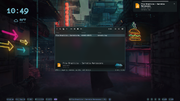
Radio stream: https://kdradio.top/listen/kd_balearic/radio.mp3
Last edited by hhh (Yesterday 23:22:17)
Why why why why?!!???
Offline
#22 Yesterday 16:28:31
- hhh
- Hercule Poirot
- From: Belgium
- Registered: 2015-09-17
- Posts: 17,495
- Website
Re: (Wayland forky/sid) HowTo: deb packages for niri-wm (easy!)
I'm not sure if I've mentioned Templates in noctalia-settings yet. Enable GTK3 and 4, QT, niri, and papirus-icons (in Community templates). The last should color folder icons automatically if Papirus is installed to /usr/share/icons and used via GTK Settings, and the papirus-folders script is installed as root...
wget -qO- https://git.io/papirus-folders-install | shIn GTK Settings (nwg-look), disable overwriting the GTK4 file under the 'Prefernces" tab.
Why why why why?!!???
Offline
#23 Today 06:57:28
- unklar
- Back to the roots 1.9

- From: #! BL
- Registered: 2015-10-31
- Posts: 3,093
Re: (Wayland forky/sid) HowTo: deb packages for niri-wm (easy!)
^It's floating... 

Thank you so much for your support!
I remember reading something about the "hated rounded corners" somewhere from you... I'll find it again. 
I'll be back in a week. I have to go to Styria to see my daughter. She's turning 45.
Offline