![[BunsenLabs Logo]](/img/bl.svg)
You are not logged in.
- Topics: Active | Unanswered
#1 2016-06-08 01:14:29
- Horizon_Brave
- Operating System: Linux-Nettrix

- Registered: 2015-10-18
- Posts: 1,474
Ham Radio
Hey everyone, so as if I didn't have enough on my plate, I'm going to be studying for my Ham Radio license for the summer. Are there any other fellow Hams on these boards? Do you guys regularly broadcast/listen? I'm actually studying for this, as a way to understand waves, radio, the electro-magnetic force, and their band waves more. I figure it's a good easier step into the world of physics that I envy so much.... Plus radio itself is pretty neat.
If this thread doesn't garner any other participation, I may use it as a blog of my progress through the material, and hopefully others behind me may make use if it... Anyway, I have my book and my pencil and scratch pad ready to go!

"I have not failed, I have found 10,000 ways that will not work" -Edison
Offline
#2 2016-06-08 01:16:06
- Eraph
- Member

- From: /au/qld/bne
- Registered: 2016-02-29
- Posts: 282
- Website
Re: Ham Radio
Well I must admit it's not something I've considered doing myself, but I'll be keen to follow your progress for sure.
Lenovo IdeaPad Yoga 13 | BunsenLabs Hydrogen (x64)
Intel Core i7-3537U | Intel HD4000 | 8GB DDR3 | 256GB SSD
Offline
#3 2016-06-08 08:04:30
- pvsage
- Internal Affairs

- Registered: 2015-09-29
- Posts: 1,433
Re: Ham Radio
Very interesting, Horizon_Brave! Is Morse Code still required learning?
Be excellent to each other, and...party on, dudes!
BunsenLabs Forum Rules
Tending and defending the Flame since 2009
Offline
#4 2016-06-08 16:10:38
- Horizon_Brave
- Operating System: Linux-Nettrix
- Registered: 2015-10-18
- Posts: 1,474
Re: Ham Radio
Hey pvsage, no Morse Code (CW) isn't required for the exams anymore, but it's still encouraged that you at least know the basics. I'll probably be focusing more on the electrical and physics portion of the exam...Waves...propogation...electro-magnetism has always fascinated me..
"I have not failed, I have found 10,000 ways that will not work" -Edison
Offline
#5 2016-07-11 02:49:01
- Horizon_Brave
- Operating System: Linux-Nettrix
- Registered: 2015-10-18
- Posts: 1,474
Re: Ham Radio
Well, on Saturday I successfully passed my Technician HAM radio license! I can now legally transmit on the 2 meter, 6 meter bands, ,70cm and a few other spots on the frequencies. No other Hams are on these forums?? Oh well... Anyway for those interested I'll be detailing a bit of how I studied, a brief guide to ham radio, and some reasons why you guys should get involved!
Part I
Resources Used:
The Official ARRL Ham Radio License Manual 3rd Edition
Electronics For Dummies
Various issues of Nuts and Volts
Ugly's Electronics Reference Book
The ARRL Website
The WISC-online practice tool
Ham College Podcast
How Radio Works
So I'll start at the beginning. A radio wave starts from emitting from an antenna.
is the radio wave's frequency. Other antenna that are tuned to pick up that exact frequency will "pick up"
It's a signal that constantly reverses direction. The constant rate of how often it fluxes like this
the wave and transmit it back to voice, or digital data etc..
So Radio waves technically is a *huge* band range of frequencies. They can range from 3kHz all the way to
300 GHz. The hz at the end is just the way to "Clock" the frequency of the wave. So let's pick a random amount...
228.83 MHz. That means the device you are using, sent out an electro-magnetic wave that is oscillating at
228.83 times a second.

What is Bandwidth?
This was sort of cool to find out. But in terms of RF and signaling, the term Bandwidth may not mean the exact
same thing as we use. I dare say that we computer folk may use the term bandwidth rather loosely and maybe
not correctly actually.
Modulation An Intro
To communicate using radio waves (or any type of wave actually...) We need 3 things.
A Carrier Wave: This is a continous constant wave at some specified frequency. Let's just say it's 99.3 MHz.
As stated, this means that the wave is oscillating up and down at 99.3 Million times per second.
That being said...it's just an empty wave of electro-magnetic awesomeness. Without adding anything to it,
if we were to receive the wave on our radio, we would just hear the whine of the base signal. There would be
nothing to listen to. So we need a 2nd thing. We need to modulate or change the wave in such a way that it
becomes meaningful. There are many many ways to apply actual meaning messages onto a wave.
The easiest, "cheapest" and fastest, is what Hams refer to as CW. Or Continious Wave. The rest of the world knows it better as Morse Code.
What this does is takes that carrier wave I was talking about, the one going at a certain speed, and switch it on and off. Sound familiar? On / Off,
Ones and Zeros? Morse Code or CW, was the first digital means of communication!
Now obviously this has it's limitations...no human speech is involved and it requires both parties "Speak" the language plus it takes time to transmit and then
receive and translate it. There are other modes of modulating a carrier though. Like Amplitude modulation and Frequency Modulation. Both methods have some unique properties that allow us to do some neat things. This includes the really clever "hacky" idea of Single Side Band modulation.
I'll return to AM and FM in a bit.
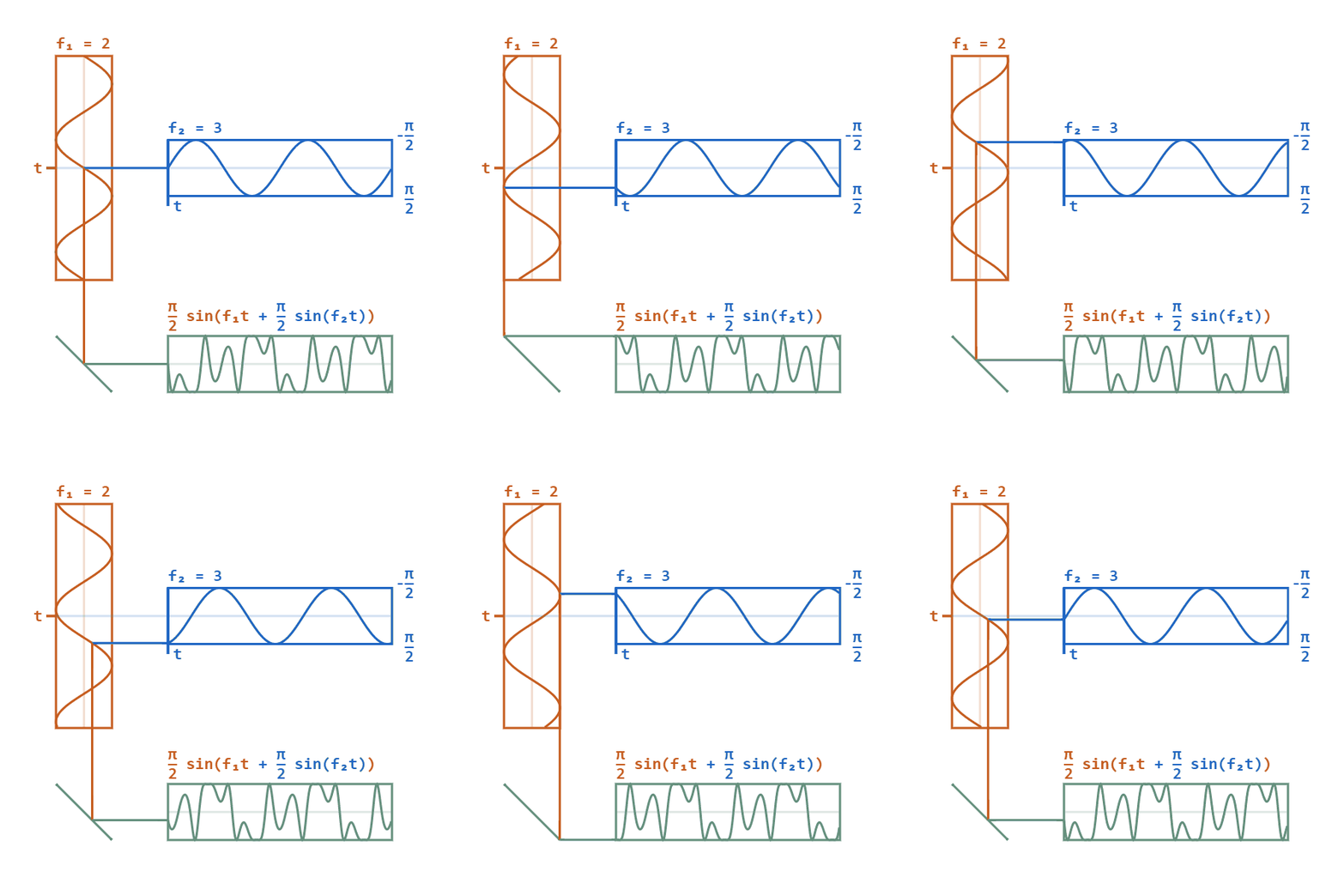
Then there's the oddball PM, or Phase modulation... I still don't fully understand this type of modulation myself, but it involves combining both the
carrier and second frequency (your voie for example) and sort of "half shifts" the original carrier wave, so that when it's "supposed" to be at zero,
the output wave is changed to it's peak value... It's weird..take a look here to induce a headache.
https://upload.wikimedia.org/wikipedia/ … lation.gif
Digital Modulation:
The above modes of modulation are "analog" They mess with the wave form of the carrier wave. (remember the carrier goes at the frequency that we set it to.)
There are other modes of modulation, referred to as digital modulation. (To me this is where the fun begins)
HAM radio has a method of sending data through the internet. This is done with something akin to a modem that we used to use for dial up. And of course some translation software is needed as well. So what does this provide? We can communicate by typing messages on our computers, that are sent to our radio transreceiver, which is sent through the antenna, to whoever we're attempting to contact! Note what I said... I didn't mention anything about our routers or ISP. That's right, the computer sends the message to the TRANSCEIVER. Which then transmits the data to the receiver! Modes of digital transmission include multiple frequency shift keying (MFSK), wireless local area networks (WLAN), D-STAR, Codec2, and Automatic Packet Reporting System (APRS). The most common and popular of this method uses Phase Shift Keying module, and the protocol is called PSK-31... I'll end here for this part, and hopefully have whetted your appetite for part II. I'll go more deeply into digital transmission of radio signals, more modulation and the different frequency bands...
Last edited by Horizon_Brave (2016-07-11 02:59:01)
"I have not failed, I have found 10,000 ways that will not work" -Edison
Offline
#6 2016-07-11 06:46:34
- Head_on_a_Stick
- Member

- From: London
- Registered: 2015-09-29
- Posts: 9,093
- Website
Re: Ham Radio
Well, on Saturday I successfully passed my Technician HAM radio license!
Congratulations!
Offline
#7 2016-07-11 07:02:43
- Head_on_a_Stick
- Member
- From: London
- Registered: 2015-09-29
- Posts: 9,093
- Website
Re: Ham Radio
Radio waves technically is a *huge* band range of frequencies. They can range from 3kHz all the way to
300 GHz
Actually, radio waves comprise the entire lower frequency range of the electromagnetic spectrum -- that largest radio waves could theoretically span the entire Hubble volume in a single wave with a commensurately infinitesimal frequency.
8)
Offline
#8 2016-07-11 07:59:30
- pvsage
- Internal Affairs
- Registered: 2015-09-29
- Posts: 1,433
Re: Ham Radio
^ Conceivable, but what would the bandwidth be at that frequency, where would you put the transmitting array, and how would you detect the signal? 
One-way communications platforms in the ELF band (30-300Hz) have been developed by the US and former Soviet Union for communication with submerged submarines; the transmitters require dedicated power stations, the antennas are poles buried deep in poorly-conductive earth dozens of meters apart, and the bandwidth is limited to a few characters per minute. VLF (300-3000Hz) is marginally more practical and two-way communication is possible, but for amateur radio (e.g. equipment that a civilian might be able to use from his house), 3KHz is the practical lower limit.
Be excellent to each other, and...party on, dudes!
BunsenLabs Forum Rules
Tending and defending the Flame since 2009
Offline
#9 2016-07-11 08:30:12
- Nili
- Member

- From: $HOME/♫♪
- Registered: 2015-09-30
- Posts: 1,294
- Website
Re: Ham Radio
Congratulation Horizon_Brave! I wish you to succeed in this project.
♫♪ JPOP listening...
Offline
#10 2016-07-11 08:54:30
- brontosaurusrex
- Senior Associate, Middle Office

- Registered: 2015-09-29
- Posts: 2,777
Re: Ham Radio
Starting the boat lectures tomorrow (Next will be UHF radio license, at least that is the plan).
Last edited by brontosaurusrex (2016-07-11 10:56:46)
Offline
#11 2016-07-11 18:44:30
- Horizon_Brave
- Operating System: Linux-Nettrix
- Registered: 2015-10-18
- Posts: 1,474
Re: Ham Radio
^ Conceivable, but what would the bandwidth be at that frequency, where would you put the transmitting array, and how would you detect the signal?
One-way communications platforms in the ELF band (30-300Hz) have been developed by the US and former Soviet Union for communication with submerged submarines; the transmitters require dedicated power stations, the antennas are poles buried deep in poorly-conductive earth dozens of meters apart, and the bandwidth is limited to a few characters per minute. VLF (300-3000Hz) is marginally more practical and two-way communication is possible, but for amateur radio (e.g. equipment that a civilian might be able to use from his house), 3KHz is the practical lower limit.
Yea, I was about to say, operating and using such low low frequencies would be quite a challenge to receive. Imagine the size of the antenna needed for those!
From Wikipedia:
Because the length of the antenna must be at least a substantial fraction of the length of the waves. Simply put, a 3 Hz signal would have a wavelength equal to the distance EM waves travel through a given medium in one third of a second. The wavelength is 299,792 km (186,282 mi) per second divided by 50–85 Hz, which equals around 3,500 to 6,000 km (2,200 to 3,700 mi) long. This is comparable to the Earth's diameter of around 12,742 km (7,918 mi). Because of this huge size requirement, to transmit internationally using ELF frequencies, the Earth itself forms a significant part of the antenna, and extremely long leads are necessary into the ground.
The fact that the Earth itself is used as part of the antenna is just so cool to me...
"I have not failed, I have found 10,000 ways that will not work" -Edison
Offline
#12 2016-07-11 18:50:49
- Head_on_a_Stick
- Member
- From: London
- Registered: 2015-09-29
- Posts: 9,093
- Website
Re: Ham Radio
https://www.nrao.edu/pr/1999/vlba/background/
EDIT: Sorry for the topic drift!
:8
Last edited by Head_on_a_Stick (2016-07-11 18:51:31)
Offline
#13 2016-07-11 22:03:24
- Horizon_Brave
- Operating System: Linux-Nettrix
- Registered: 2015-10-18
- Posts: 1,474
Re: Ham Radio
No way! Still very on topic...besides I haven't written up part 2 yet..
"I have not failed, I have found 10,000 ways that will not work" -Edison
Offline
#14 2016-07-12 01:18:24
- jalexander9
- Member

- Registered: 2015-11-08
- Posts: 152
Re: Ham Radio
@Horizon Brave - Kudos on your new ham radio certification! And similar interests on physics and electronic hardware and their utilities, from earlier periods of my own life, would have been great - I'm glad you brought those interests into practice.
Cross-continent communication, operating your own broadcast network, the skies the limit. Good luck with this new endeavor!
Offline
#15 2016-07-12 03:19:41
- Horizon_Brave
- Operating System: Linux-Nettrix
- Registered: 2015-10-18
- Posts: 1,474
Re: Ham Radio
Thanks jalexander!
What's really neat is that recently with the emergence of SDR (software defined radio) it's not a lot easier and most importantly cheaper to get into radio. I've been looking up videos and tutorials of older hams and they discuss the large separate boxes that were used years and year ago. While I love older big clunky hardware, getting into radio and having to drop like 400-600 dollars on a receiver, transmitter, antenna, microphone, power supply, amplifier etc...
But nowadays, these functions are slowly being integrated into singular devices. Infact for like 20 bucks you can get a usb dongle that can pick up UHF/VHF signals. (granted you probably won't get great quality audio but hey, 20 bucks compared to 400??
Plus with things like Repeaters (dedicated amateur run radios that do the same thing that a repeater access points do) you can extend your range for miles!
As I'm planning to get into with my next post, this all does come at a cost though. My first transceiver I got off amazon, a cheap Chinese made Baofeng hand held radio that only receives on the UHF and VHF bands. (nothing below 6meters) And it's all FM based. So I can't do a lot of the really cool AM communication methods like Single Side Band...
"I have not failed, I have found 10,000 ways that will not work" -Edison
Offline
#16 2016-07-15 17:01:34
- Horizon_Brave
- Operating System: Linux-Nettrix
- Registered: 2015-10-18
- Posts: 1,474
Re: Ham Radio
Holy Cripes...who ever said getting into Ham Radio was cheap sold me a pack of goods... The transceiver that I want is nearly 800 dollars. And that's without any antenna, wiring, and the optional amplifier....
Take my Money
Anyway, the radio that I have now is a handheld Baofeng, and while it literally does work, it can only send and recieve on the UHF/VHF bands. The type of radio that I want to get into is more on the HF bands. What's the difference? Well...
Obviously not all radio frequencies operate the same. Certain bands of frequencies have some unique properties. For example, as we were discussing above, the longer the wavelength, the lower the frequency is. Which if you think about it, makes logical sense. If the wavelength is very long, it means that it takes a longer time to make one cycle. So the frequency of those cycles in a second is lower. Anyway, a big factor is radio transmission is the effect of the Ionosphere. The Ionosphere a few hundred miles up, plays a big role is which radio waves are released into space, or which ones are 'reflected', and sent back down to earth.
In very general terms, the lower wavelengths (in the HF band for us hams) are reflected back down to earth much easier than the higher frequency waves. Why does this happen? Well it's all in the name! The ionosphere, (not surprisingly) is chock full of loose, meandering, ions. This is an effect of the sun blasting the ionosphere with radiation.
So what does this matter? Well if given the right conditions, you can send an HF transmission which may perhaps radiate outward for say 4 miles, to hit a repeater, which may then slingshot the signal outward further and have it be bounced back down to earth at an angle covering hundreds of miles! So this is much harder to do with higher frequency wavelengths. The UHF / VHF bands normally can push through the layers of the ionosphere and break out into space. This means that for long distance communication, the lower HF bands and below are needed.
Anyway I got my General class license book so I'm all set to begin! I would really love to get into Single Side Band and the more digital themed modes, like PSK-31...
Last edited by Horizon_Brave (2016-07-15 17:01:48)
"I have not failed, I have found 10,000 ways that will not work" -Edison
Offline
#17 2016-08-02 18:10:42
- Horizon_Brave
- Operating System: Linux-Nettrix
- Registered: 2015-10-18
- Posts: 1,474
Re: Ham Radio
Boy...talk about sticker shock. So since actually getting my ham license, and eagerly looking forward to studying for my General class, I made the mistake of
beginning to look at transceivers that would be able to make use of the lower frequency bands of HF. Holy crap, getting a real set up, with a decent transceiver,
antenna, Power supply, cables and some form of grounding..
I went from a 35 dollar chinese made Baofeng HT that is basically my entire base station...so looking at a real HF basestation that may cost me 800-1k for the
transceiver itself! This is pretty much on par with buying an entire home entertainment system. There's used equipment available, which is the route I may have to
take, but even then, the prices are very high. Maybe I'll save 200-400 dollars perhaps, but I also want something that isn't going to spark when I flip the switch.
I'm looking currently at trying to dig up a used ICOM 720a, which is great for all modes of transmit/receive. Exactly what I'm looking for, but actually finding
one that isn't on par with gold, is harder.

That's the 720a. Nice sturdy looking piece of equipment
"I have not failed, I have found 10,000 ways that will not work" -Edison
Offline
#18 2016-08-02 19:45:53
- cloverskull
- Member
- Registered: 2015-10-01
- Posts: 348
Re: Ham Radio
Not a HAM guy but a former military guy. My job required me to have a pretty intense understanding of radio, rf theory, and things of that nature. Very exciting indeed. Get your license, get a good radio and telescope, and go make a comm shot to the ISS while simultaneously viewing them as they pass overhead
Offline
#19 2016-08-02 21:16:21
- Horizon_Brave
- Operating System: Linux-Nettrix
- Registered: 2015-10-18
- Posts: 1,474
Re: Ham Radio
lol, well the whole "good radio and telescope" points to the previous post's theme of... It's all so expensive!! 8.(
"I have not failed, I have found 10,000 ways that will not work" -Edison
Offline
#20 2016-08-08 00:20:43
- Horizon_Brave
- Operating System: Linux-Nettrix
- Registered: 2015-10-18
- Posts: 1,474
Re: Ham Radio
While not 100% Ham related, I was able to pick up some really cool gear! I scored a Techtronix 2465 Oscilliscope (measures AC, ground and DC waves), plus a Wave signal generator (so I can feed signal to the oscilliscope to measure of course!) AND a 13v power supply, that I can use to power my transceiver if i ever get one... Plus I was able to snag some good cables for everything. All for 50 bucks.
Some pics below. 


Last edited by Horizon_Brave (2016-08-08 08:41:38)
"I have not failed, I have found 10,000 ways that will not work" -Edison
Offline